Eureka! Copper Canyon 1312 Eight-Person 13- by 12-Foot Family Tent
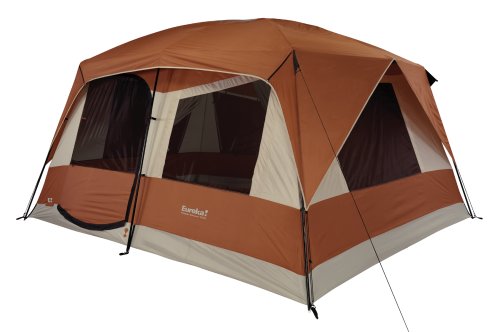 Featuring vertical walls for maximal internal space, this 13-foot x 12-foot (156 square feet) freestanding cabin-style tent accommodates up to eight campers on cots. The tent includes a removable curtain so it can be divided into two rooms as well as being configured as a single room. Two D-shaped doors with side flaps permit private entry into each room and have large #8 zippers with covers for durability and rain protection. Six large zippered mesh windows open for visibility and airflow and close for privacy. Toggles keep window flaps off the floor and out of the way. A detachable awning shades the front. A fly with clear-panel skylights permits stargazing and includes pockets for storing storm guyouts when not in use. A port allows an extension cord (not included) to be run into the tent. A sweep-out point facilitates housekeeping. A hanging gear-loft supplies convenient storage.
 Made of 1200mm, 75D polyester, the tent has nine steel and fiberglass poles that slip into sleeves during setup. Frame clips and ring-and-pin assemblies also facilitate setup. Mesh screens out insects as small as no-see-ums. The tent weighs 37 pounds and has a center height of 7-foot-3.
Eureka! tents' standard design features include bathtub-style floors that wrap up the sides to keep water out; nickel sliders and self-healing zippers; and factory-taped major seams to seal out weather.
Key Details:
- Floor Size: 13 x 12 feet
- Pack Size: 10 x 28 inches
- Center Height: 7' 3"
- Minimum Weight: 37 pounds
- Tent Area: 156 square feet
- Seasons: 3
- Sleeps: 5-6
- Doors: 2
- Windows: 6
- Wall Fabric: 75D polyester taffeta, 1200 mm
- Fly Fabric: 75D StormShield polyester, 1200 mm
- Floor Fabric: 75D polyester taffeta, 1200 mm
- Mesh Fabric: 68D no-see-um
- Frame: 12.65 mm fiberglass and 19.5 mm steel
 |
| The spacious Copper Canyon 1312 tent offers 156 square feet of room for sleeping and storage. |
About Eureka!
Though the exact year is unknown, Eureka's long history begins prior to 1895 in Binghamton, New York, where the company still resides today. Then known as the Eureka Tent & Awning Company, its first wares were canvas products--most notably, Conestoga wagon covers and horse blankets for nineteenth century American frontiersmen--as well as American flags, store awnings, and camping tents.
The company increased production of its custom canvas products locally throughout the 1930s and during the 1940 and even fabricated and erected the IBM "tent cities" just outside Binghamton. The seven acres of tents housed thousands of IBM salesmen during the company's annual stockholders meeting, which had since outgrown its previous locale. In the 1940s, with the advent of World War II and the increased demand for hospital ward tents, Eureka expanded operations and began shipping tents worldwide. Ultimately, upon the post-war return of the GIs and the resultant housing shortage, Eureka turned its attention to the home front during the 1950s by supplying awnings for the multitude of mobile homes that were purchased.
In 1960, Eureka's new and innovative Draw-Tite tent, with its practical, free standing external frame, was used in a Himalayan Expedition to Nepal by world renowned Sir Edmund Hillary, the first person documented to summit Mt. Everest only six years earlier. In 1963, Eureka made history during its own Mt. Everest ascent, with more than 60 of its tents sheltering participants from fierce 60+ mph winds and temperatures reaching below -20°F during the first all American Mt. Everest Expedition.
For backpackers and families, Eureka introduced its legendary Timberline tent in the 1970s. Truly the first StormShield design, this completely self-supporting and lightweight backpacking tent became one of the most popular tents the entire industry with sales reaching over 1 million by its ten year anniversary.
Eureka tents have also traveled as part of several historic expeditions, including the American Women's Himalayan Expedition to Annapurna I in 1978 and the first Mt. Everest ascents by a Canadian and American woman in 1986 and 1988. In recent history, tents specially designed and donated by Eureka sheltered Eric Simonson and his team on two historic research expeditions to Mount Everest, this time in a quest for truth regarding the 1924 attempted summit of early English explorers George Mallory and Andrew Irvine. During the 1999 expedition, the team made history finding the remains of George Mallory, but the complete mystery remained unsolved. Returning in 2001 to search for more clues, the team found amazing historical artifacts which are now on display at the Smithsonian.
Amazon.com Tent Guide
Selecting a Tent
Fortunately, there are all kinds of tents for weekend car campers, Everest expeditions, and everything in-between. Here are a few things to keep in mind:
Expect the Worst
In general, it's wise to choose a tent that's designed to withstand the worst possible conditions you think you'll face. For instance, if you're a summer car camper in a region where weather is predictable, an inexpensive family or all purpose tent will likely do the trick--especially if a vehicle is nearby and you can make a mad dash for safety when bad weather swoops in! If you're a backpacker, alpine climber or bike explorer, or if you like to car camp in all seasons, you'll want to take something designed to handle more adversity.
Three- and Four-Season Tents
For summer, early fall and late spring outings, choose a three-season tent. At minimum, a quality three season tent will have lightweight aluminum poles, a reinforced floor, durable stitching, and a quality rain-fly. Some three-season tents offer more open-air netting and are more specifically designed for summer backpacking and other activities. Many premium tents will feature pre-sealed, taped seams and a silicone-impregnated rain-fly for enhanced waterproofness.
For winter camping or alpine travel, go with a four season model. Because they typically feature more durable fabric coatings, as well as more poles, four-season tents are designed to handle heavy snowfall and high winds without collapsing. Of course, four-season tents exact a weight penalty of about 10 to 20 percent in trade for their strength and durability. They also tend to be more expensive.
Domes and Tunnels
Tents are broadly categorized into two types, freestanding, which can stand up on their own, and those that must be staked down in order to stand upright. Freestanding tents often incorporate a dome-shaped design, and most four-season tents are constructed this way because a dome leaves no flat spots on the outer surface where snow can collect. Domes are also inherently stronger than any other design. Meanwhile, many three-season models employ a modified dome configuration called a tunnel. These are still freestanding, but they require fewer poles than a dome, use less fabric, and typically have a rectangular floor-plan that offers less storage space than a dome configuration. Many one and two-person tents are not freestanding, but they make up for it by being more lightweight. Because they use fewer poles, they can also be quicker to set up than a dome.
Size Matters
Ask yourself how many people you'd like to fit in your fabric hotel now and in the future. For soloists and minimalists, check out one-person tents. If you're a mega-minimalist, or if you have your eye on doing some big wall climbs, a waterproof-breathable bivy sack is the ticket. Some bivy sacks feature poles and stake points to give you a little more breathing room. Also, if you don't need bug protection and you want to save weight, check out open-air shelters.
Families who plan on car camping in good weather can choose from a wide range of jumbo-sized tents that will accommodate all your little ones with room to spare. A wide range of capacities is also available for three- and four-season backpacking and expedition tents. Remember, though, the bigger the tent you buy, the heavier it will be, although it's easy to break up the tent components among several people in your group. It's also helpful to compare the volume and floor-space measurements of models you're considering.
Customer Review: Love this tent!
Also am new to the 'family' tenting vacation. Have done a lot of tent camping as a single person many many years ago so this is a new experience for me. As with many of the other reviewers, I based my decision on online research and other reviewers opinions. Took the plunge with this tent and 'so far' couldn't be happier. We did as most people recommended, read the instructions first, then pulled everything out of the box and sorted the poles then started assembling. From the time it took us to lay out the bungy poles to finally pegging down the tent it took a maximum of 20 mins for husband to have it up (with the help of our little 5 yr old). Will definately be able to set it up faster second time around (and with out the help of our little one :-). Definately am glad that we did not try it for the first time in the dark but am sure if you are used to putting up large tents it wouldn't be a problem, very easy. Slept in it for the one night and just LOVED the open screened roof. Gave a fantastic uninterrupted view of the stars. Don't know what it is like in wind and a bad rain storm but so far we are very happy with our purchase and can't wait to go camping in it.
Customer Review: Great tent
We set up the the tent in the rain, very easy set up. There was an all night down pour, not a drop of rain in the tent, is was very cold at night used coleman heater to stay warm, because of the size of the tent two heaters were needed. Did O.k. trying to stay warm.. I would recommend this tent to anyone looking for a cabin style (big) tent.
Canvas, a woven plain fabric is an important accessory in the field of painting. Beside paintings, it is used for making tents, sails, backpacks and marquees. The word is derived from the Arabic word "cannabis". It is known for its sturdiness and durability and can be used in making shoes and handbags. Thus, it has multiple uses and it has become an essential thing in various aspects.
Canvas a Base for Painting:
The most conventional use of canvas is painting. This is said to be the most reliable base for oil painting. Before an oil painting is done on the canvas, it is coated. This coating actually prevents the oil paints from coming in contact with the fibers. On most of the occasions, this coating is done by synthetic latex. Traditionally, it used to be made by the linen fibers. However, it is in 20th century that cotton ones came into the picture. It was known as cotton bucks. Modern painters use cotton stretch canvas. Cotton ones are usually lighter than other cotton fabrics like denim.
They are available in two types - plain and duck. The threads of the duck cotton are tightly woven. Cotton canvas is susceptible to get wrinkled. Generally, pressing warm iron over the wet surface of cotton canvas is done to flatten the surface. Readymade sheets are also available in the market in various sizes.
Oil painting is quite a popular genre of painting. On canvas, the colors of painting emerge more brightly.
For more information please visit Ethnic Paintings.
Rajneesh Dubey is Content Coordinator for http://ethnicpaintings.com This website gives you comprehensive informations on painting history, development, trends, popular painting styles, great painters, famous paintings, painting galleries and museums, painting tips, painting classes. In other words, this website is a treat to painting freaks.
posted by allegria--vhkioqxi at 10:31 PM


0 Comments:
Post a Comment
<< Home